open products

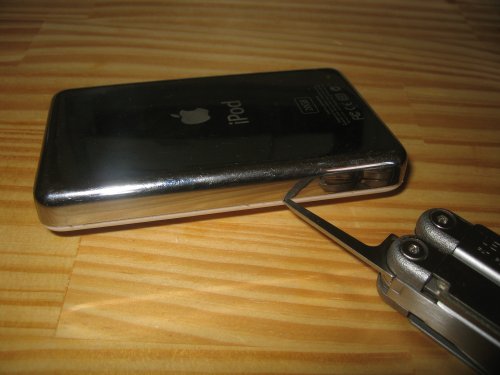
01 start opening iPod.jpg

the makers’ bill of rights rests on the simple premise of making products easy to operate and modify by using commonly available parts and designing them to be replaced or modified. it could stand as the beginning of an open-source industrial design philosophy. among its many advantages are that open products can last longer, and that the modifications done by hackers today could become standard features to consumers tomorrow. here it is:

Meaningful and specific parts lists shall be included – Cases shall be easy to open – Batteries should be replaceable – Special tools are allowed only for darn good reasons – Profiting by selling expensive special tools is wrong and not making special tools available is even worse – Torx is OK; tamperproof is rarely OK – Components, not entire sub-assemblies, shall be replaceable – Consumables, like fuses and filters, shall be easy to access – Circuit boards shall be commented -Power from USB is good; power from proprietary power adapters is bad – Standard connecters shall have pinouts defined – If it snaps shut, it shall snap open – Screws better than glues – Docs and drivers shall have permalinks and shall reside for all perpetuity at archive.org – Ease of repair shall be a design ideal, not an afterthought – Metric or standard, not both – Schematics shall be included

Posted in open objects, product design | Comments closed

revealing brushstrokes

raffaello

maurizio seracini was an originator in using medical imaging techniques for analysis of ancient art. his firm editech analyzes art and architecture with with invisible wavelengths to reveal earlier layers that reveal the process behind the artwork. in rafael’s woman with a unicorn (above) he discovered that the controversial mythical creature actually hides a common puppy.

Posted in visualization | Comments closed

soft wing

soft wing

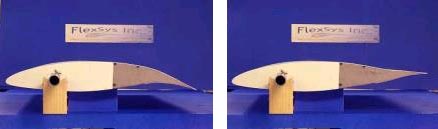
following my theory that in the future everything will be soft and glow :rubber manufacturer flexsys is working with the air force on an adaptive compliant wing that replaces mechanical flaps with a rubber actuated mechanically inside the wing.

via the new york times

Posted in livingbreathing, materials | Comments closed

sketch board

sketch board
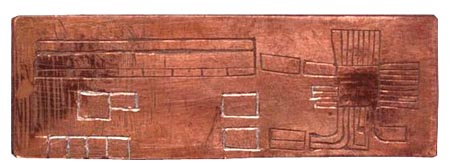
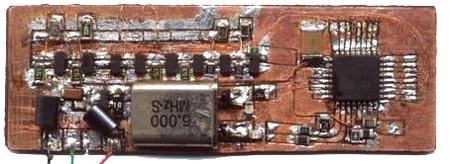
this image inspires me: no need for fab labs, with a knife you can scratch out a circuit board from copper.

sketch board
via MAKE

Posted in fabrication, open objects | Comments closed

projection rebellion

swastika projection by wodiczko

ever since i heard of krysztof wodiczko’s projection of a swastika onto the south african embassy in london in 1985, i have been fascinated by the subversive power of projection. who owns the display? lately protesters of boston university’s biolab (a hazardous research facility slated to be located in a dense, poor urban neighborhood) have used projection in two languages to get their point across:

stop the bu biolab projection

via meiver

Posted in guerilla | Comments closed

healthy spam

spam lite

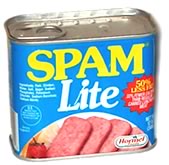
lately i’ve been interested in what social good can be achieved by spam. ron plotnikoff led a study entitled Efficacy of an e-mail intervention for the promotion of physical activity and nutrition behavior in the workplace context which looked at the effect of unsolicited emails promoting healthy behaviors on the health of recipients. people who received the healthy spam increased physical activity, reduced the body-mass index and were more open to diet change (whereas the control group gained weight). seems that spam not only caters to our basest instincts, it can motivate them in the first place.

Posted in marketing | Comments closed

laser knife

wicked lasers

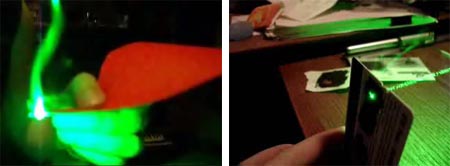
i’ve been waiting for years to replace my xacto knife with a hand-held laser. wicked lasers makes a number of portable lasers capable of burning through paper or plastic from a few meters away with only 200mW. too bad they’re only for ‘scientific use’

via gizmodo

Posted in fabrication | Comments closed

cement screen

cementscreen.jpg

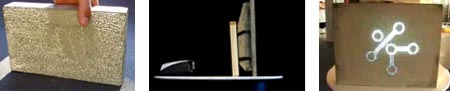
innovation lab has exploited the idea of light-transmitting concrete to make a screen out of cement. the system works with a projector behind a wall filled with horizontal optical fibers. we all know that soon every surface can become an interface, but is this the way? with architecture-scale displays, resolution can be low while brightness needs to increase. it remains to be seen whether paintable displays or simply LED matrices will make a better (and thinner) wall display. also, this material is unlikely to be structural since it contains no rebar or aggregate and cannot resist bending.
via we-make-money-not-art

Posted in materials | Comments closed