xray vision

veinviewer.gif

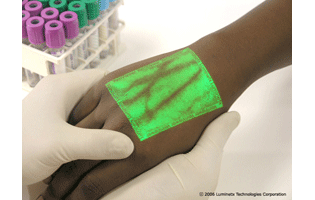
augmented reality describes the application of computer interfaces onto the real world, usually by overlaying objects with computer graphics either through projection or a head-mounted display. popularized by x-ray glasses, this idea has actually had few popular applications because it’s really hard to accurately map the real world with digital information. one of the most sophisticated augmented reality products to date is the veinviewer (above) which captures and projects back an infrared camera image of the body, revealing the location of veins. unlike head-mounted displays, projection directly onto the object makes it possible for multiple people to share the same information and for the patient to better understand what’s happening.

Posted in 2d, livingbreathing, open objects, soft/glowing, visualization | Comments closed

growing chair

childrenspaperchairsub03.jpg

children grow so fast that it’s a challenge to fit their bodies and their interests for more than a few months at a time. as a result a lot of toys and furniture are cheaply made and readily disposed of – all because of bad design. charlotte friis design studio conceived of this easel with a large roll of paper that doubles as a chair. the roll of paper travels through the easel as children draw, creating two seats of different heights on either side of the drawing surface. the chair can support bodies large and small, and is built largely from the artwork that always accompanies a child’s development. after they are grown the system becomes an archive of the child’s physical and artistic development.

via

Posted in art, children, customization, product design | Comments closed

life is a game

humanpacman.jpg

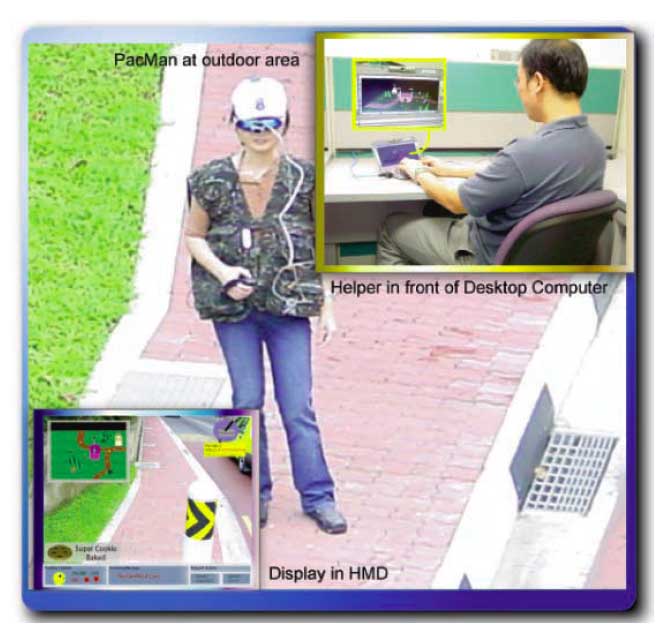
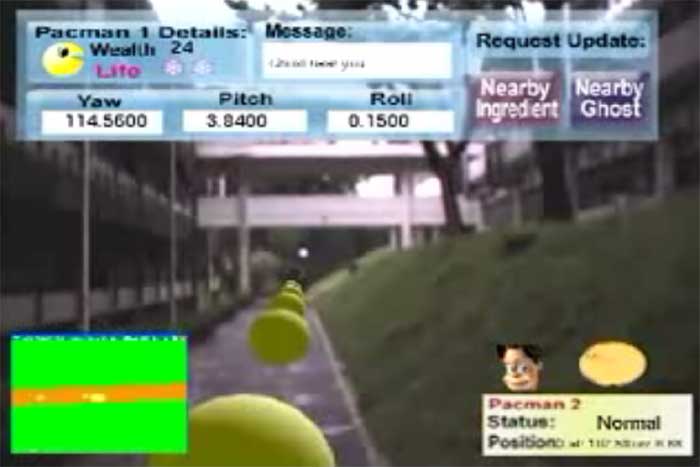
the mixed reality lab at the national university of singapore built a new kind of video game that you play in real life: human pacman. the system works through a very ungainly wearable computer that overlays everyday paths with yellow spheres that you pick up to collect points. there are also cookies, for energy, and some of your fellow pedestrians plugged in to the system are ghosts which you must avoid. like any other wearable technology, it has a way of keeping you from seeing the real world and the people around you. on the other hand, this is a lot better than traditional video games because it encourages you to go out and interact with a new community, transforming boring spaces and everyday activities into exciting and playful adventures.

humanpacman2.jpg

there is a conference paper and a journal article that describe the system in detail, and a youtube video:

Posted in conviviality, hyperexperience, livingbreathing, perception, visualization | Comments closed

sore loser

handjawb.jpg

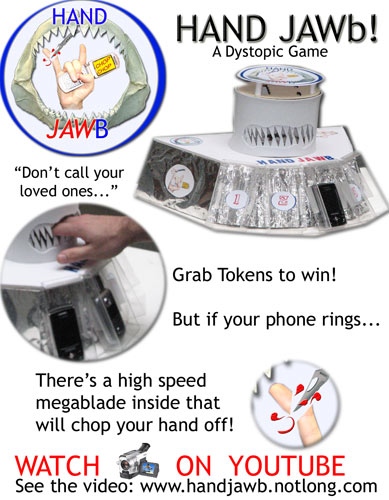
jay silver made this fake product for our technology informatoin and social control class with chris c last year. it’s a board game that reflects teenage boy antisocial angst and self-destruction. each player puts his hand in the cardboard mouth and his cell phone on the board. if the cell phone doesn’t ring the player wins! if not their hand is mauled by a blender inside. like the bocca della verita, except that instead of honesty it rewards the bigger loser.

Posted in evil robots, livingbreathing | Comments closed

remote graffiti

wiffiti-obama.jpg

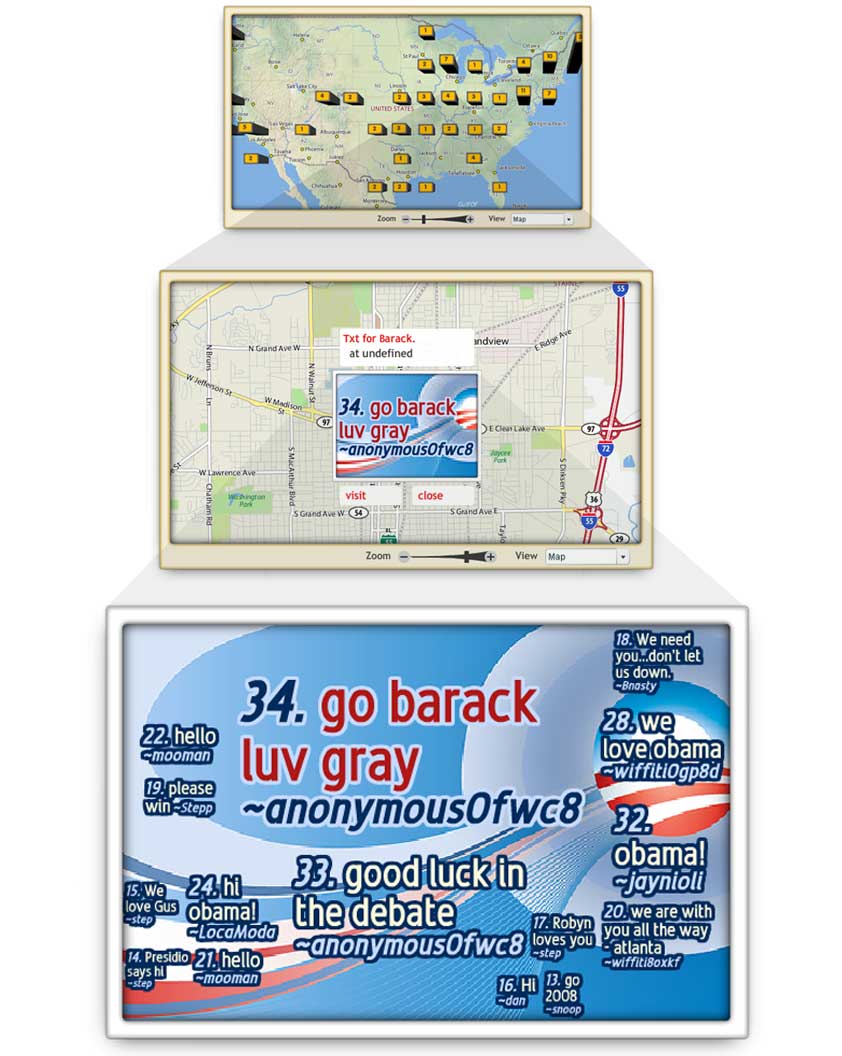
locamoda‘s wiffiti screens are large public displays to which passersby can send messages via SMS. the screens are mounted in public places like cafes, restaurants, and increasingly workplaces. recently wiffiti screens have begun to serve a political role: they are mounted in (among other places) barack obama‘s springfield IL campaign headquarters, hillary clinton‘s albany NY headquarters and the recent yearlykos convention. in the cafe context i have watched the wiffiti screen at my local coffee shop toscanini’s get steady use, especially when it goes into a ‘game mode’ and strangers in the same room start a heated word-game competition (without acknowledging each other). it’s not nearly as obnoxious as a big screen TV usually is, but it’s not exactly a portrait of democracy either: every screen is censored and the ones used behind political candidates as they speak are as open as the youtube presidential debates. the main contributions seem to be the ability to send a message to a place, not a person, and the implicit definition of graffiti as the voice of the public.

Posted in 2d, blogogracy, conviviality, visualization | Comments closed

animated label

there’s something about stop-motion animation that appears real, maybe because of its physicality of because of all those smart materials and the promises of nano-technology. i just get the feeling that one day all of the things around us are going to be able to come to life. this beringer commercial uses exquisite stop motion made from white paper to illustrate the richness hidden inside the plain label on the bottle of wine. it also looks like it was a blast to make.

Posted in animation, marketing, materials | Comments closed

paint it white

extinguisherevolution.jpg

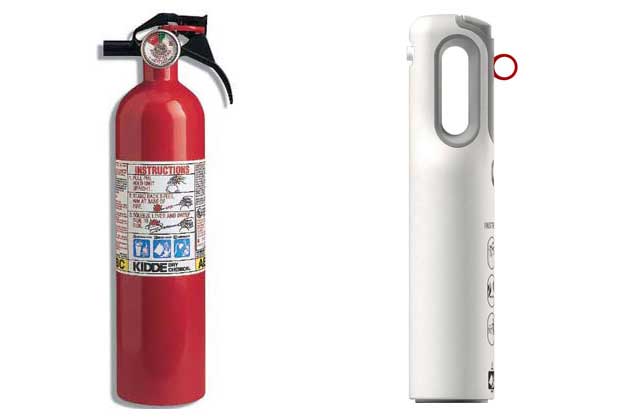
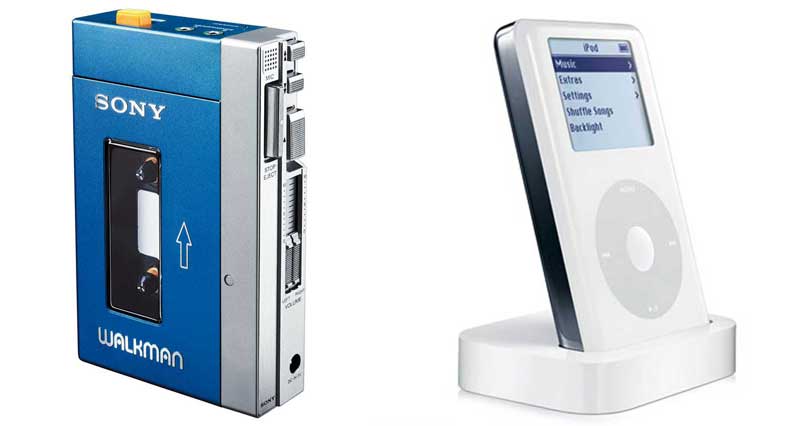
in today’s new york times magazine rob walker talks about the new fire extinguisher on sale at the home depot – the home hero – which replaces our old extinguishers with something more ‘designer.’ presumably the aesthetic appeals to design-conscious consumers who will be more likely to keep it at hand – although there is no evidence of this. recently it seems like making anything out of white plastic – with rounded edges – means ‘design.’ i totally disagree. there is a lot of design in the old extinguisher, namely that it could be seen, understood and used in a pinch. it’s a universal symbol. and the new extinguisher is not good design – it’s just bland. lately, it seems like design means the type of simplicity that obfuscates the function of an object to make it seem ‘better’ than the competition. i guess it all started with the walkman2.0, a blander version of the original. the walkman and the original fire extinguisher each have a unique design language. how good will ‘design’ be when everything looks the same?

walkmanevolution1.jpg

Posted in marketing, product design | Comments closed

second office

secondoffice4.jpg

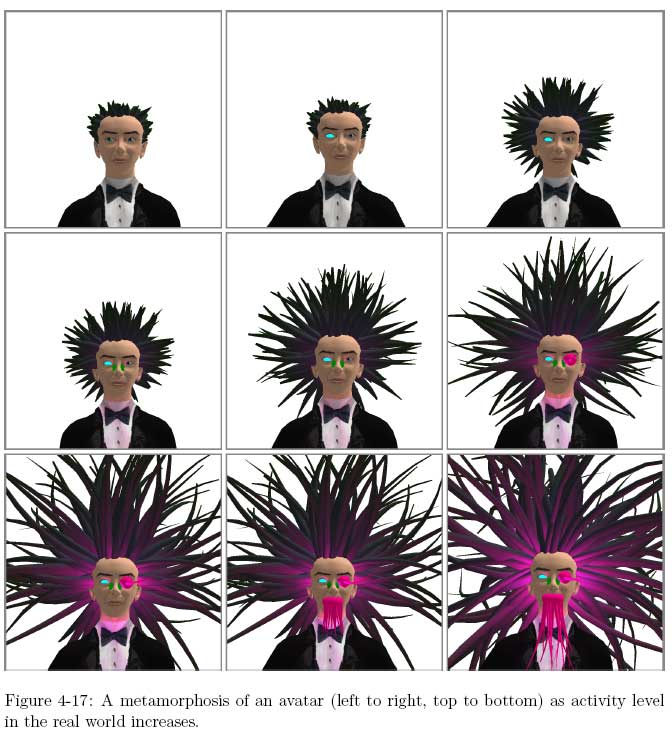
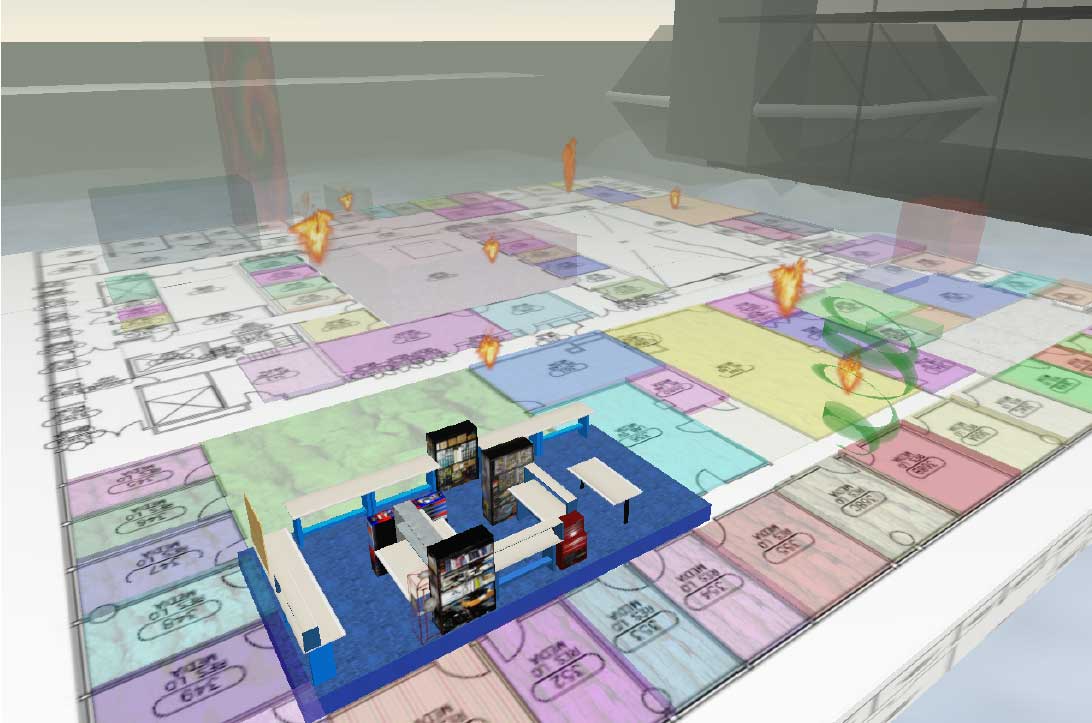
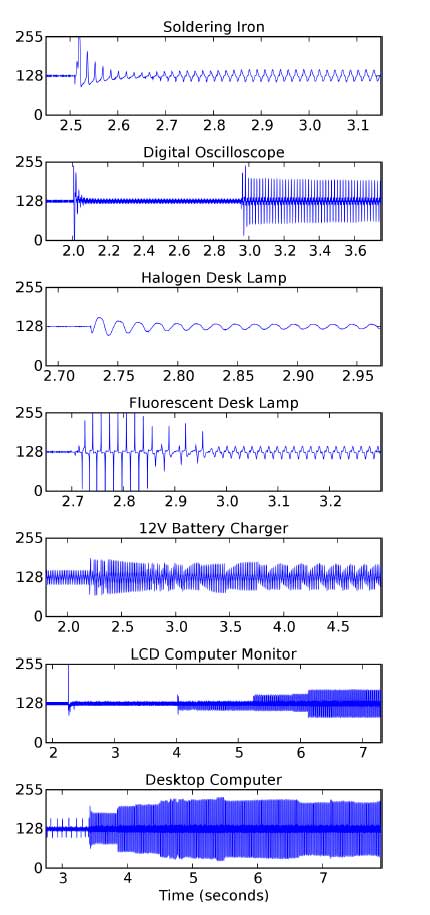
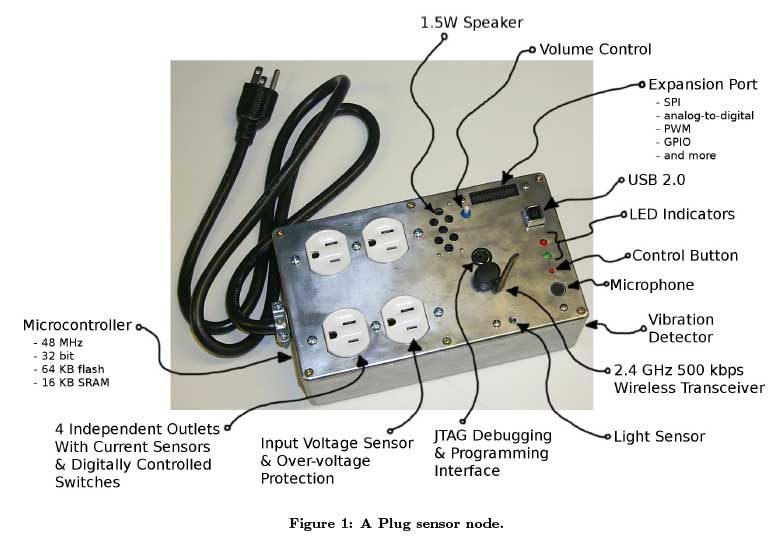
josh lifton (of pushpin computing fame) presented his work on ‘dual reality‘(pdf) at the moda+tecnologia event. as part of his phd thesis he deployed activity sensors all around the medialab which look (and act) as power strips, but they record activity in the form of sound level, power consumption and movement. the data is collected in a virtual copy of the building housed in second life where it is represented by abstract animations such as josh’s avatar growing wild medusa hair if things go crazy (above). aside from being able to know who’s in their office and when, this kind of intimate connection between the physical and virtual worlds could make possible all sorts of remote collaboration and control. you can easily find out how much different machines are consuming when you’re in the office or away, and you can also arrange meetings in the common virtual office while working from distant but probably cozier home offices. eventually a second office could evolve for each of us where all of the resources and people we depend on are conveniently located in one beautiful non-existent office.

secondoffice1.jpg secondoffice2.jpg secondoffice3.jpg

Posted in 3d, blogogracy, hyperexperience, surveillance, visualization | Comments closed